Binance Review: Cheap Fees Weighed Against a Long Rap Sheet
We checked Binance's live spot fee schedule and trading interface against its BNB discount and VIP tiers, then set the resulting savings against a $4.3 billion settlement, an exit from several countries and a US arm that still cannot offer everything the main platform does.
By The Hashmere Test Desk3 min read
7.5/107.5/10
Our verdict
Binance's 0.10% base spot fee, cut further with BNB or trading volume, undercuts most rivals we have tested, and the order books we watched on major pairs are as deep as any exchange in this category. That price comes bundled with a $4.3 billion 2023 settlement over sanctions and Bank Secrecy Act violations, exits from the UK, Netherlands and Canada, and a separate, more limited Binance.US for American residents, so the low fees only tell half the story.
Best for: Active traders outside the US who want low fees and deep liquidity and accept the regulatory baggage
Base spot fee of 0.10% maker and taker beats most mainstream exchanges
Paying fees in BNB cuts that rate by a further 25%
VIP tiers fall as low as 0.025% maker and 0.031% taker at high volume
Order books on major pairs like BTC/USDT stay deep even during fast moves
What held it back
A $4.3 billion settlement in 2023 covered sanctions and Bank Secrecy Act violations
Binance exited the UK, Netherlands and Canada after regulatory action in each
Binance.US operates separately with no perpetual futures and state-by-state limits
MiCA rules forced USDT off EEA spot pairs for European users in March 2025
We pulled Binance's live fee schedule, watched the BTC/USDT order book during a fast afternoon move and read through the settlement documents that explain why the exchange looks different depending on which country you're sitting in.
The fee schedule is genuinely hard to beat
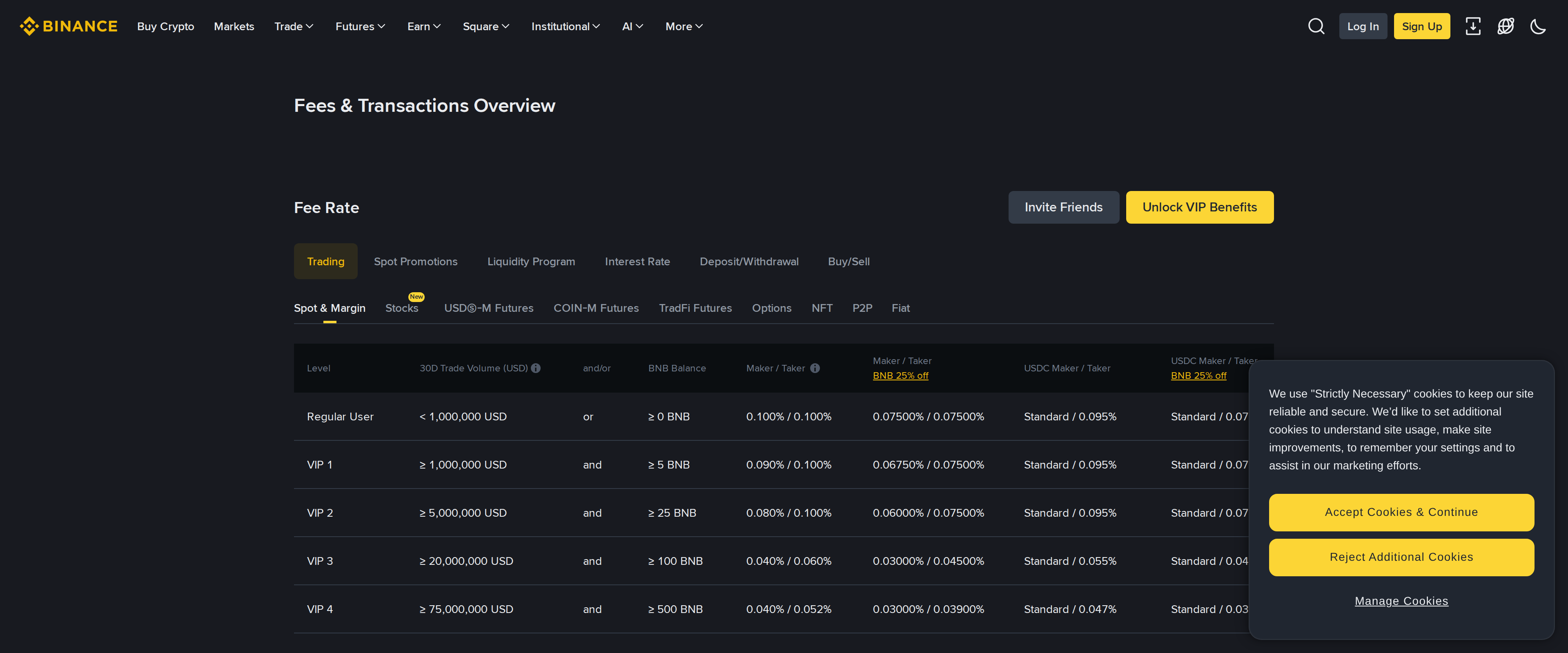
Binance's base spot tier charges 0.10% maker and 0.10% taker, a rate that already sits below Coinbase's standard tier and matches or beats most exchanges we cover. Pay those fees in BNB and Binance knocks a further 25% off, dropping an active retail trader's effective rate close to 0.075%. Climb the nine-level VIP ladder on volume and BNB holdings and the top tier falls to 0.025% maker and 0.031% taker, numbers built for market makers rather than a weekend trader but visible to anyone on the public schedule (binance.com/en/fee/trading).
Binance's live fee schedule page, listing spot trading fee tiers by 30-day volume
Liquidity you can actually see moving
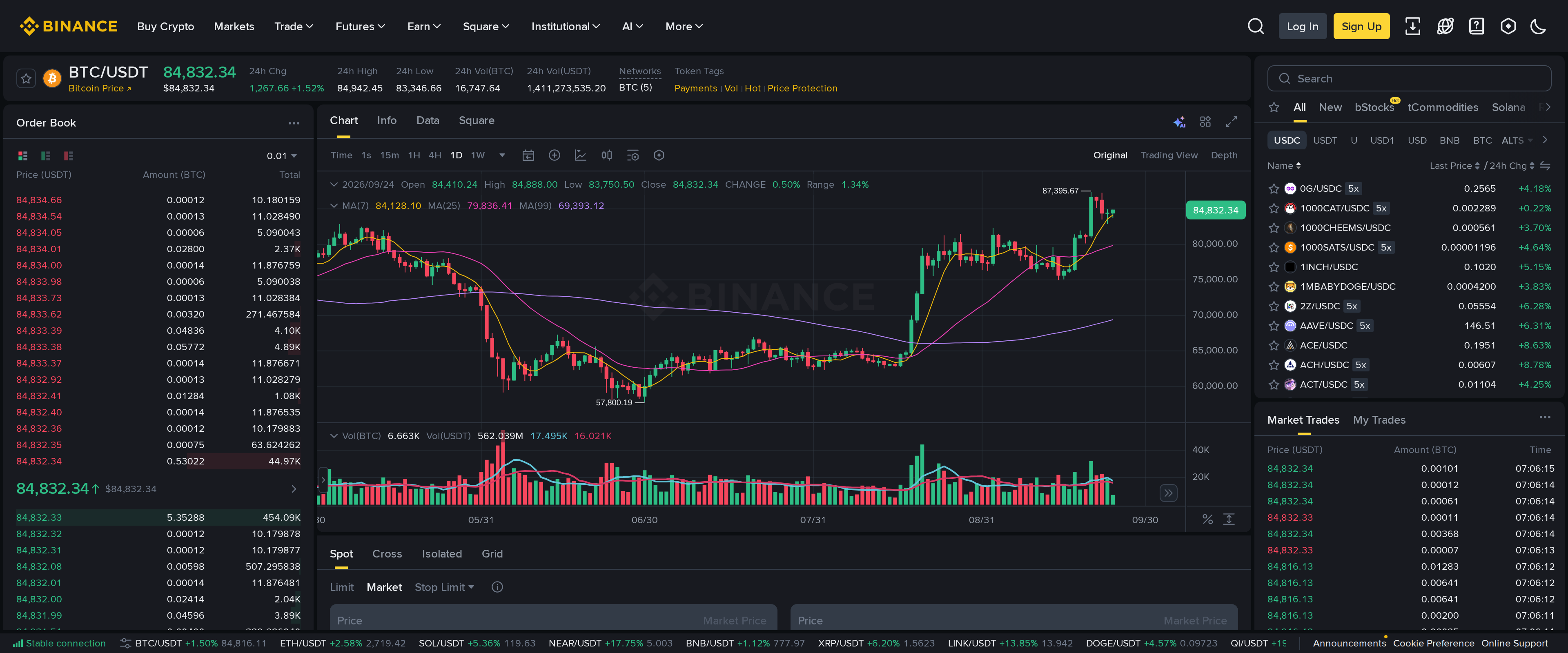
Numbers on a fee page mean little without volume behind them. We opened the BTC/USDT spot chart during an ordinary afternoon and watched the order book absorb market orders without the price jumping the way it does on thinner exchanges. That depth is Binance's real competitive edge over smaller platforms: cheap fees only matter if there is enough liquidity on the other side of your trade to fill it at the price you expected.
Binance's spot trading interface for BTC/USDT, showing live price charts and order book depth
The $4.3 billion reason to read the fine print
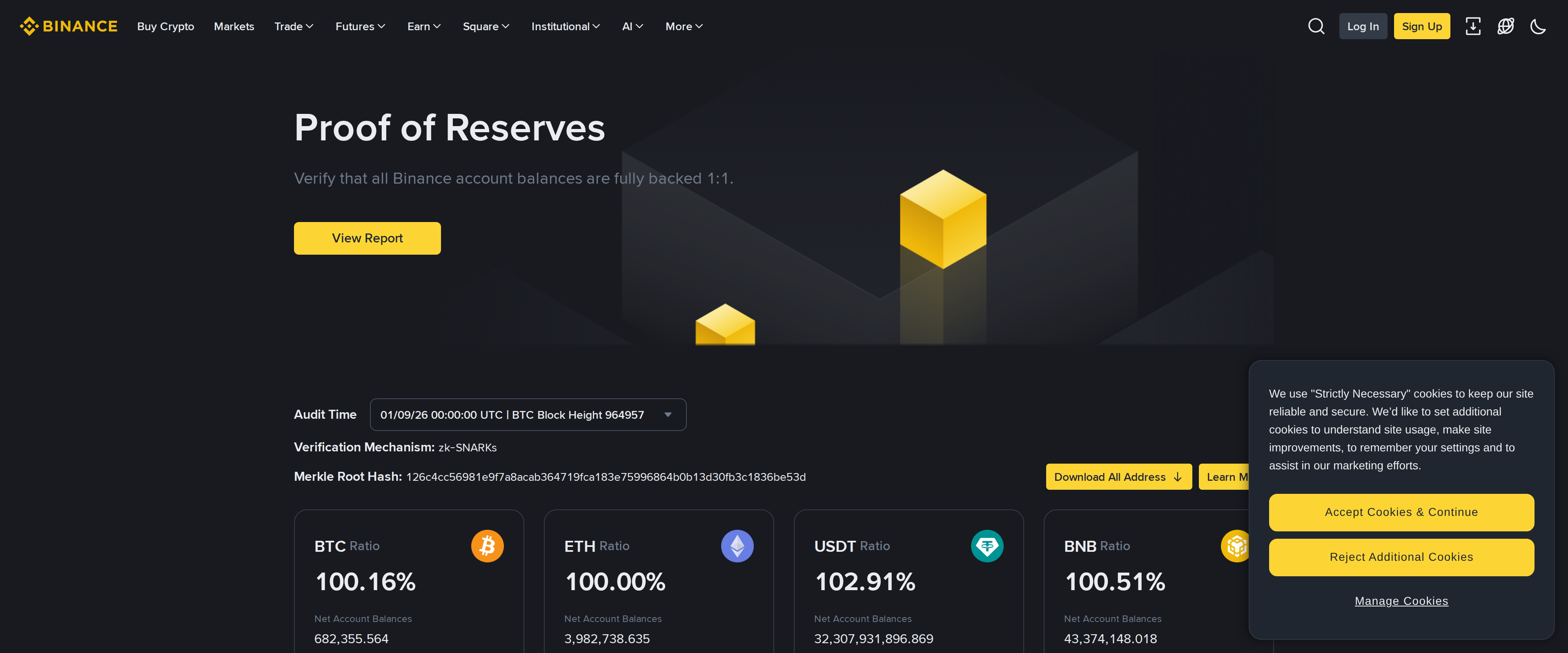
In November 2023, Binance agreed to a $4.3 billion settlement with the US Department of Justice, FinCEN, OFAC and the CFTC, covering Bank Secrecy Act violations and unlicensed money transmission dating back to 2017. Binance also publishes quarterly Proof of Reserves data, showing balances like a 100.16% BTC ratio and 102.91% USDT ratio at the audit we checked, a transparency step that predates the settlement but has become more visible since.
Binance's Proof of Reserves page, showing coverage ratios for BTC, ETH, USDT and BNB
Reading the settlement documents themselves is a useful exercise for anyone tempted to wave the number away as a cost of doing business. The charges describe years of Binance knowingly serving US customers while publicly claiming to have exited the market, the kind of gap between statement and practice that regulators treat far more seriously than a simple licensing oversight.
The settlement wasn't the only regulatory chapter. The UK's FCA revoked Binance's permissions in 2023, the Netherlands fined it €3.3 million before a full market exit that same year, and Canada saw a complete withdrawal in October 2023. India blocked the platform in early 2024 over unregistered operation, then let it back once Binance registered and paid a penalty. Founder Changpeng Zhao received a presidential pardon in October 2025, and the SEC dropped its own lawsuit against the exchange that May, developments that have eased but not erased the regulatory history.
Product breadth beyond spot trading
Binance's account covers far more than spot pairs: margin, futures, staking, a launchpad for new token listings and a card product all sit under the same login. That breadth is convenient if you want one exchange for everything, but it also means the platform carries more regulatory surface area than a spot-only competitor, since futures and margin products draw scrutiny in jurisdictions that tolerate simple buying and selling. Several of the country exits described above were specifically about derivatives access rather than the exchange as a whole.
What US and EU users actually get
American residents cannot use Binance's main platform at all; Binance.US operates as a separate entity restricted state by state, offering spot trading and staking but no perpetual futures, since those require CFTC-regulated infrastructure the US arm has never held. European users lost access to USDT on spot pairs in March 2025 as Binance phased out non-MiCA-compliant stablecoins across the EEA, a compliance step that changes which pairs are actually tradable depending on where you live.
Who this actually suits
If you live somewhere Binance still operates without restriction and you trade often enough that a 0.075% fee difference compounds into real money, the platform's price and liquidity are hard to match elsewhere. If you're in the US, budget for Binance.US's narrower feature set instead, and if regulatory history matters to your choice of custodian as much as fees do, weigh the settlement and market exits alongside the numbers on the fee page before funding an account. Nothing here is advice to trade with leverage or move funds you can't afford to lose.